
The digital puzzle landscape shifted dramatically in 2022. While the world was obsessed with simple five-letter guesses, a new contender emerged that required a different kind of brainpower: spatial logic. The Waffle Game isn’t just about knowing words; it’s about understanding how they intersect and move within a fixed physical space. This guide serves as the ultimate manual for mastering this grid-based challenge, ensuring that your morning coffee is always accompanied by a 5-star performance.
The Origin and Philosophy of the Waffle Game
Every great game has a story, and Waffle’s is one of pure independent creativity. Developed by James Robinson, the game was born out of a desire to create a “solvable” jumble. Unlike games where you are punished for not knowing an obscure word, Waffle gives you every single letter you need right from the start. The challenge isn’t “What is the word?” but rather “Where does this specific letter go to make sense of the whole?”
This philosophy has turned Waffle into a “kind” game. It doesn’t rely on trickery. It relies on the player’s ability to visualize the finished product. Because the letters are already there, the game feels more like a mechanical puzzle—like a Rubik’s cube made of vowels and consonants—than a traditional vocabulary test.
The Anatomy of the Waffle Grid
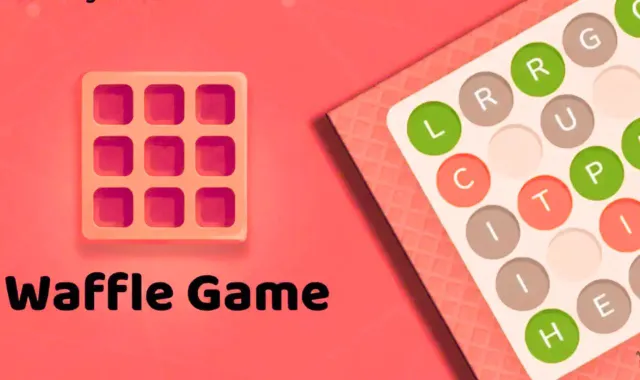
Before you make your first move, you must understand the “terrain.” The 5×5 grid is not a solid block. It consists of:
- Three Horizontal Lines: Rows 1, 3, and 5.
- Three Vertical Lines: Columns 1, 3, and 5.
- Four Empty Quadrants: These are the “holes” in the waffle where no letters are placed.
This structure means that some letters are more important than others. The letters at the corners (e.g., top-left, top-right) and the center-points are “intersections.” They belong to two words at once. If you get an intersection letter wrong, you are effectively getting two words wrong simultaneously. This is where most players lose their moves.
Mastering the Color-Coded Feedback System
The feedback system is your only compass in the Waffle Game. However, many beginners misinterpret what the colors are telling them.
- The Green State: When a tile turns green, it is perfectly placed. It is “bolted down.” You can no longer click it or swap it. Your goal is to turn all 21 letters green.
- The Yellow State: This is the most complex part of the game. A yellow tile means the letter is in the correct word, but the wrong position. However, because many tiles are at intersections, a yellow tile at a corner could belong to the horizontal word or the vertical word.
- The White/Gray State: These letters are “lost.” They do not belong in the row or column where they currently sit. They need to be swapped to a completely different area of the grid.
Understanding the Move Economy
In Waffle, “Moves” are your currency. You start with 15 moves. Every time you swap two letters, you spend one move.
| Performance Level | Moves Remaining | Star Rating | Skill Tier |
| Perfect | 5 Moves Left | ⭐⭐⭐⭐⭐ | Grandmaster |
| Excellent | 3-4 Moves Left | ⭐⭐⭐⭐ | Expert |
| Great | 1-2 Moves Left | ⭐⭐⭐ | Intermediate |
| Standard | 0 Moves Left | ⭐⭐ | Casual |
| Fail | Out of Moves | 0 Stars | Beginner |
The game is mathematically designed so that every puzzle can be solved in exactly 10 moves. This means that to get 5 stars, every single swap you make must result in two letters turning green (or one turning green and another moving into a yellow position that sets up a final green move).
Step-by-Step Strategic Approach for Beginners
If you are looking to move from a 2-star player to a consistent 4-star or 5-star winner, you need a system. You cannot just swap letters randomly and hope for the best.
Step 1: The Visual Scan
Spend the first 60 seconds just looking. Do not click. Look at the gray letters and see if they obviously belong elsewhere. For example, if you have a “Q” in a gray box and there is a “U” in another part of the board, your brain should immediately start looking for where that “QU” pair fits.
Step 2: Solve the “Non-Intersections” First
Sometimes, it’s easier to solve the middle of a word (positions 2 and 4 in a 5-letter word) because those letters only belong to one word. By clearing the “easy” middle letters, you narrow down the possibilities for the difficult corner intersections.
Step 3: The “Wait and See” Method
If you have a yellow letter at an intersection and you aren’t sure if it belongs to the horizontal or vertical word, leave it alone. Move other letters around it. Often, the surrounding letters will turn green, and by process of elimination, the intersection’s identity will be revealed without you having to waste a move guessing.
Advanced Tactics: The “Double-Green Swap”
The “Double-Green Swap” is the holy grail of Waffle strategy. This occurs when you take a letter from a position where it is gray/yellow and swap it with another letter, and both letters land in their permanent green homes.
To find these, look for “Reciprocal Needs.” If Position A needs the letter currently in Position B, and Position B needs the letter currently in Position A, that is a 100% efficient move. Professional players spend minutes searching for these pairs before making a single click.
Linguistic Patterns to Memorize
Because waffle game uses standard English words, you can use linguistics to your advantage.
- Vowel Placement: In 5-letter words, the second and fourth letters are very often vowels (A, E, I, O, U). If you see a consonant in a middle spot and it’s not forming a blend (like “TH” or “CH”), it’s likely in the wrong place.
- Common Endings: Words frequently end in “Y,” “E,” “S,” or “T.” If you have these letters available, test them at the ends of your horizontal and vertical lines.
- The “S” Trap: Many players assume an “S” at the end of a word means it’s a plural. In Waffle, words are often verbs (like “TRETS”) or unique nouns that just happen to end in S. Don’t let a trailing S fool you into thinking the word is simple.
The Deluxe Waffle: A Different Beast
Once you have mastered the daily 5×5, the Deluxe Waffle awaits. This is a 7×7 grid. The complexity doesn’t just double; it triples. You have more moves, but the number of intersections increases, meaning a single mistake can cascade through the entire board.
In Deluxe mode, the “Center” of the grid is the most important area. Because the center words intersect with so many others, solving the middle “cross” of the 7×7 grid should be your primary objective. Once the center is stable, the four outer edges become much easier to manage.
The Social and Educational Value of Waffle
Why has Waffle remained so popular while other games fade? It’s the community. The “Share” button allows players to post their colored grids without spoiling the words. This “spoiler-free” social sharing creates a daily conversation among friends and coworkers.
Educationally, Waffle is a powerhouse. It forces players to recognize anagrams and improves “orthographic processing”—the ability to recognize letter patterns and word shapes. Many teachers have begun using the Waffle Archive as a classroom tool to help students with vocabulary retention and logic.
FAQs
Is there a dictionary I can use if I get stuck?
While the game does not include a built-in hint button, you can click on any completed word at the end of the game to view its definition through Merriam-Webster or similar dictionary websites.
Can I play Waffle offline?
The Waffle app allows limited cached play, but the daily puzzle requires an active internet connection to sync the global “Word of the Day.”
What is a Waffle Streak?
A Waffle Streak tracks how many consecutive days you successfully solve the puzzle. Missing a day or failing to complete the puzzle within 15 moves will reset the streak to zero.
Why are some letters already green when the game starts?
To ensure the puzzle is solvable within 15 moves, the game provides a few pre-correct (green) letters at the beginning. These act as starter clues to guide your strategy.
How are the words chosen for Waffle?
The developer uses a curated list of commonly used English words. Extremely technical terms or obscure slang are avoided to keep the game fair and accessible.
Does it cost money to play the Archive games?
No, the Waffle Archive is completely free to play. However, players can optionally support the project via Ko-fi to receive perks like an ad-free experience.
Is Waffle available in other languages?
The official version is currently available only in English. However, due to its popularity, community-created versions and fan-made grids exist in several other languages.
Conclusion
The Waffle Game is a rare gem in the world of online puzzles. It combines the linguistic satisfaction of a crossword with the logical rigor of Sudoku. By understanding the grid anatomy, respecting the move economy, and looking for those elusive “Double-Green Swaps,” you can elevate your game and join the ranks of the 5-star elite.
Whether you’re playing on your commute or during a lunch break, Waffle offers a perfect, bite-sized mental workout. Now that you have the tools and strategies, it’s time to put them to the test. Head over to the official site and see if you can solve today’s grid with moves to spare!
